

It’s Never Too Late to Be Who You Might Have Been By Judi Moreo
Somewhere in the hustle of life, we forget. We forget that we once dreamed of more. That we once believed in possibilities. That we once whispered bold ideas to ourselves in the quiet moments before doubt crept in. Over time, responsibilities, fears, and the opinions of others crowd out those dreams until they fade into a distant “what if.” But here’s the truth: It’s never too late to be who you might have been.
History is filled with people who prove this point. People who defied expectations—not only society’s, but their own. People who woke up one day and decided that their story wasn’t over yet. That their best chapter hadn’t been written. That they were ready to become more.
Take Grandma Moses, for instance. Anna Mary Robertson Moses was a farmer’s wife who spent decades raising children, tending to chores, and living the simple life. It wasn’t until arthritis made embroidery too painful that she picked up a paintbrush at the age of 78. That small decision changed the trajectory of her life. Her art became wildly popular, eventually displayed in galleries around the world. She became an icon, not because she started young, but because she started. Had she believed it was too late, we’d have lost a treasure trove of folk art and the powerful reminder that creative expression knows no age limit.
Or consider Colonel Harland Sanders. Most of us know him as the white-suited face of Kentucky Fried Chicken, but few realize he didn’t create that empire until he was 65. After a string of failed ventures and rejections, Sanders hit the road with a pressure fryer, a secret recipe, and a dream. Over 1,000 restaurants turned him down before someone finally agreed to work with him. The rest is fried chicken history. Sanders’ story isn’t about luck—it’s about grit, reinvention, and the refusal to let age be a barrier to impact.
These are not exceptions; they’re examples.
Every day, someone decides to pick up the thread of a dream they laid down long ago. A mother sends her last child off to college and finally applies to culinary school. A retired teacher writes the novel she’s been outlining in her head for 30 years. A man in his 50s leaves corporate life to open a bike shop and lead weekend adventure tours. A grandmother starts a nonprofit to mentor teenage girls. They are everyday people choosing to rewrite the next chapter instead of rereading the old ones.
To read Judi’s soul-stirring and transformative full article, click on this link and look for page number 47. Get your FREE access to Empowering Humanity Magazine™ Now!

5 Keys To Unleash Your Self-Confidence By Pragito Dove
Self-confidence is a deeply rooted feeling that we are okay, loved, and matter…that what we say, do, and feel…matters.
When we miss this key ingredient, life can become hell. So, let’s turn the hell into heaven right now with these five keys that work to unleash your self-confidence, joy, and creativity. And here’s the good news: your self-confidence is already there, waiting to be freed up and expressed.
1- LAUGH, A LOT, EVERY DAY!
Laughter is the first key because this is the easiest way to get your self-confidence going. You get a powerful kick-start from laughter to get positive energy flowing. Make a deliberate practice of bringing more laughter into your life every day. You might have to “fake it ‘til you make it” initially, but soon laughter flows naturally and spontaneously. Every child is born full of laughter, and that includes you. Laughter benefits your body, mind, heart, and soul. It erases fear (you can’t laugh and be afraid at the same time!), unleashes your innate joy and creativity, and enhances all your relationships, not to mention bringing fun, relaxation, and love into your world.
2- MEDITATE!
Practice the laughter meditation. Stage one: laughter. Stage two: sit in silence. This is the easiest way to get into meditation and combines with the first key! The powerful effect of the laughter in stage one helps you drop deeper down, in the second stage, to discover the inner wisdom, silence, and stillness within you. As a result, love, peace, creativity, joy, self-respect, and self-love arise naturally and spontaneously. Your self-confidence is innate in these qualities. You find the wisdom to know that what you say, do, and feel does matter. You don’t need another person to tell you, you know.
Then, whatever other people’s opinions are, YOU know that you have something special to offer the world, and your presence here is important. We all matter.
3- LOVE YOURSELF!
Loving yourself is much easier once you have started your laughter meditation practice. Love arises naturally from laughter. Laughter IS love, isn’t it? When we laugh, we open our hearts and are in loving communion with others and ourselves. Try it! Notice how you feel; notice how your self-judgment is erased; see how other people’s judgments are dissolved; and notice how your inner joy arises and fills you to overflowing with love, creativity, and a positive outlook. What we focus on expands. Focus on loving yourself no matter what, and your self-confidence will soar. It’s true!!
To read Pragito’s empowering and insightful full article, click on this link and look for page number 54. Get your FREE access to Empowering Humanity Magazine™ Now!

Making Last Chance Memories through Caretaking a Loved One By Eileen Bild
As I navigate the role of caretaker for my 94-year-old father, there are days when I feel defeated. Yet I know this is where I am meant to be.
I am a baby boomer, born in 1964. As we are living longer, many of us, born between 1946 and 1964, and some in the next generation, are now facing the role of “parent” to our own mother and/or father, as our new norm.
At least 17.7 million Americans serve as family caregivers for individuals aged 65 and older who require assistance due to physical, mental, or cognitive limitations. (NCBI) Older adults constitute the largest group receiving care, accounting for 41% of care recipients. (Guardian Life) The average caregiving period is four years. Notably, 24% of caregivers provide care for more than five years, and 15% for a decade or longer. (Caregiver +2)
These are daunting statistics, yet it is the reality. As of 2020, approximately 53 million Americans—more than 1 in 5—were providing unpaid care to an adult, a significant increase from 43.5 million in 2015. (CDC)
58% of caregivers are women. 79% of care is for adults aged 50 or older. 76% of care recipients are aged 65 or older. Caregivers often experience physical and emotional strain. Nearly 1 in 5 caregivers report that they are in fair or poor health. (CDC)
How do we do it?
Caring for a parent or two means stepping into a role we are never trained for—nurse, counselor, advocate, and sometimes, emotional anchor. It’s deeply meaningful, but it can also feel incredibly isolating.
Imagine being on call 24/7, not for a job, but for someone you love who’s fading. You become their memory, their strength, their voice—while trying not to lose your own. To care for someone is to give up pieces of yourself, your time, your rest, your independence, so they can hold on to theirs.
It’s like running a marathon every day, emotionally. There’s love, but there’s also guilt, grief, and burnout that no one sees. Without effective tools to manage each day, part-time or full-time caretaking takes its toll.
I’m grateful that my experience as a coach, along with my Master’s in Transpersonal Psychology and practices in meditation and mindfulness, have all helped me in the demanding role of caregiver. I collected tools over the years, never thinking I would need them the most with a loved one. No matter how much I center myself through meditation and mindfulness, nothing has stretched my spirit and strength like the role of caregiver, going deep into my core.
To read Eileen’s insightful and Empowering full article, click on this link and look for page number 78. Get your FREE access to Empowering Humanity Magazine™ Now!

A Message Born from Fire: A Journey from Silent Pain to Global Impact
What if the story you’ve been hiding… is the very thing that could help heal the world?
By Dr. Aimmee Kodachian, h.c.
As I walked onto the stage in Qatar, surrounded by global leaders and dignitaries, something stirred deep inside me. I wasn’t only stepping forward—I was stepping back.
Back into the shoes of a 12-year-old girl, whose world was shattered in an instant, at the very beginning of the Lebanese Civil War. It was an unforgettable day when my favorite and older brother, Robert, was killed in front of my eyes as a bomb tore through our living room.
One second, we were having a heartfelt conversation about my dreams — he was encouraging me to become a teacher and believe in myself. Next, I was screaming his name through smoke and flames, watching his hand disappear into the fire. The bombs didn’t stop. With each explosion, the ground trembled beneath me, and I was shaken to my core.
My family became homeless — we lost everything in the blink of an eye. That moment crushed my spirit and stole my childhood.
As the war intensified, my parents placed my six-year-old brother, Roger, and me in the mountains for safety. Not long after, we lost connection with our family for several months, and I had no hope that I would ever see them again. I was a child, holding Roger tightly with each bomb that shook the ground. I had to become his protector, pretending to be strong when fear was all I knew.
That night in Qatar, I wasn’t giving a speech.
I was delivering her message of faith and hope—a message born from deep pain, when a bomb took her brother’s life. A message from a girl who suffered silently with dyslexia, couldn’t read or write, who was bullied and abused, and had every reason to give up… but didn’t.
Because God had a greater plan.
Delivering a Message That Was Never Meant to Be Mine Alone
As I spoke, I could feel my spirit leaving the stage and returning to those moments—moments of loss, silence, and holding on to hope through the ache.
I was no longer standing before world leaders. I had returned to the boarding school classroom, sitting alone at the back, unable to read the words on the page. There, I became the girl who was punished and abused by her teacher and bullied by her classmates — the one who felt broken and invisible, hiding behind her own shadow. Beyond the walls of that classroom, she was also the girl who had lost her beloved brother to the war — and with him, the last of her hope.
At my lowest point, when I had no voice, no comfort, and no sense of belonging, I was given a divine gift—what I now call the Miracle Light. It was not something I earned. It was something I was entrusted with. It lit a path I didn’t even know I could walk. And it reminded me:
God sees what others overlook.
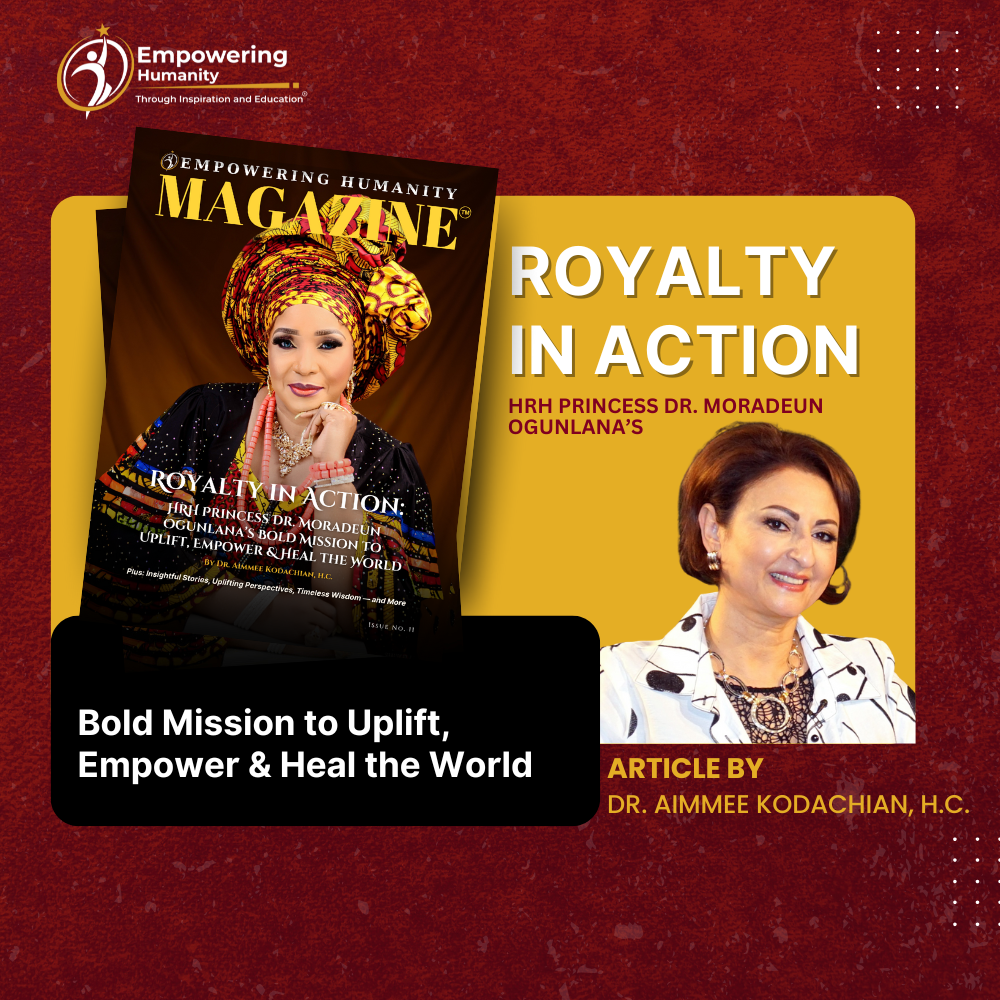
To read the full article, click on this link and look for page number 71. Get your FREE access to Empowering Humanity Magazine™ Now!